
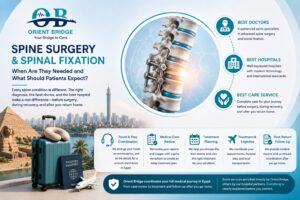






If you have been told that you may need spine surgery or spinal fixation, it is natural to have questions about what the operation involves, whether fixation is really necessary, and how recovery will affect your daily life. For patients considering treatment in Egypt, it is also important to understand how the doctor, hospital, travel arrangements, and follow-up will work before making a decision.
Spine surgery is not one single procedure. The right treatment depends on the cause of the problem, the part of the spine involved, your symptoms, and your overall health.
When Is Spine Surgery Considered?
Not every back or neck problem requires surgery. Depending on the diagnosis, doctors may first consider non-surgical treatments such as medication, physical therapy, activity modification, or other appropriate treatments.
Surgery may be considered when there is a structural problem in the spine that requires surgical treatment, when symptoms remain significant despite appropriate non-surgical care, or when there is pressure on nerves or the spinal cord that needs to be addressed.
Symptoms can vary considerably. Some patients mainly experience back or neck pain, while others may have pain travelling into an arm or leg, numbness, weakness, or difficulty with movement.
The important point is that the decision should be based on a careful medical assessment rather than symptoms alone. Imaging such as MRI or CT scans may be reviewed together with your examination, medical history, previous treatments, and other relevant tests.
For an international patient, this review can begin before travelling. Sharing your available reports and imaging allows a consultant to understand the case and develop an initial treatment plan.
What Is Spinal Fixation, and Why Might You Need It?
Spinal fixation is a surgical technique used to provide stability to part of the spine. It may involve screws, rods, or other medical implants that support the affected vertebrae while the spine heals or remains stable.
Fixation may be considered in situations involving spinal instability, certain fractures, deformity, degeneration, or as part of another spinal procedure. However, not every spine operation requires fixation.
This distinction matters. If spinal fixation has been recommended, you should understand why it is necessary in your particular case, which levels of the spine are involved, and what the expected benefits and limitations are.
You should also ask whether alternatives are appropriate and what could happen if surgery is delayed or not performed. The answers depend on your diagnosis, so general advice online cannot replace an individual assessment.
Finding the best doctor for your case means finding a spine specialist with the appropriate experience for your particular condition—not simply choosing someone because they perform a large number of operations.
How Do You Choose the Best Doctor and Best Hospital for Spine Surgery?
Spine surgery can range from relatively limited procedures to complex operations requiring extensive planning. For this reason, the best hospital for one patient may not necessarily be the best hospital for another.
The medical team should consider your diagnosis, the complexity of the operation, other health conditions, and the level of postoperative support you may require. Appropriate imaging, operating facilities, anesthesia services, nursing care, and access to additional specialists when necessary can all matter.
Before travelling to Egypt, you should have as much clarity as reasonably possible about the proposed operation. Ask what procedure is being considered, why it is recommended, how long you may need to remain in hospital and in Egypt, and what recovery is expected to involve.
The final surgical plan can sometimes change after an in-person examination or additional tests. A responsible best care service should explain this possibility rather than presenting an initial plan as something that can never change.
What Happens After Spine Surgery and Spinal Fixation?
Recovery depends heavily on the type and extent of surgery. A patient undergoing a smaller procedure may have a very different recovery from someone having multi-level spinal fixation.
After surgery, the medical team will usually provide instructions regarding movement, wound care, medications, activity restrictions, and follow-up. Some patients may also need rehabilitation or physical therapy when medically appropriate.
For international patients, the timing of the return journey deserves particular attention. You should not assume that you can fly home immediately after leaving the hospital. Your surgeon should advise when travel is medically appropriate based on the procedure and your recovery.
Before leaving Egypt, make sure you understand which symptoms require urgent medical attention and what follow-up will be needed at home.
Why Post-Return Follow-Up Matters
The medical journey does not end when you leave the hospital.
After returning home, you may need your operative report, imaging, discharge summary, medication information, rehabilitation instructions, or further communication with the treating team. Follow-up may also involve new imaging or medical reviews depending on your operation and recovery.
Orient Bridge coordinates this complete journey. It begins with a consultant review of your available medical case, followed by treatment planning and coordination of the appropriate doctor and hospital, appointments, travel, accommodation, transportation, and other practical arrangements in Egypt.
After you return home, Orient Bridge continues coordinating medical reports and treatment-related communication. Some services are billed directly by Orient Bridge, while others are billed by hospital partners, and this is explained before you commit. Costs vary according to the individual case and treatment required.
When considering spine surgery or spinal fixation abroad, the goal should not simply be to arrange an operation. It should be to find the best doctor, best hospital, and best care service for your individual condition, with a clear plan for what happens before surgery, during recovery, and after you return home.